
25 November 2004
21 November 2004
Room-temperature Bose-Einstein condensation?
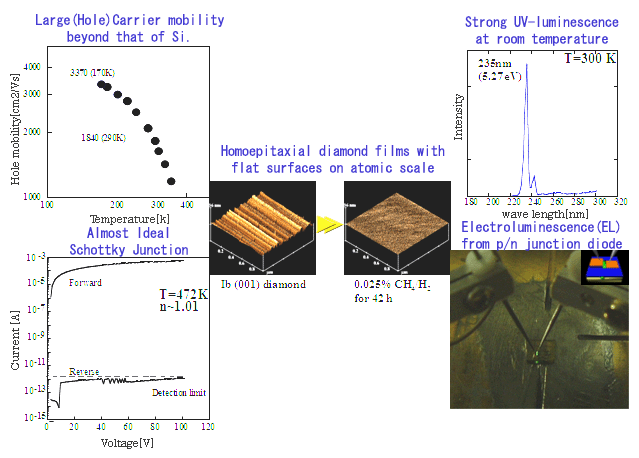
Hideyo OKUSHI, AIST Tsukuba Diamond Research Center, Japan The AIST Tsukuba Diamond Research Center has observed extremely sharp 235-nm exciton emission in fabricated single-crystal diamond film semiconductors at 300K. If the exciton lifetimes are long enough it is possible that Bose-Einstein condensation can occur in these diamond films, even at room temperature.
Hideyo OKUSHI, AIST Tsukuba Diamond Research Center, Japan The AIST Tsukuba Diamond Research Center has observed extremely sharp 235-nm exciton emission in fabricated single-crystal diamond film semiconductors at 300K. If the exciton lifetimes are long enough it is possible that Bose-Einstein condensation can occur in these diamond films, even at room temperature.
26 October 2004
Transfer of Nonclassical Properties from Microscopic Superpositions to Macroscopic Thermal States H. Jeong ,T.C. Ralph
Abstract quant-ph 0410210 "We have studied a more reasonable analogy of Schrodinger’s cat paradox where the virtual cat is a significantly mixed thermal state. Our discussion was motivated by the observation that a truly classical system cannot be in a pure quantum state. We have found that non-classical properties of microscopic quantum superpositions can be transferred to thermal states of large average photon numbers. The resulting states show strong quantum coherence and entanglement between severely mixed thermal states. Our examples are feasible in real physical systems and may be realized for some moderate cases using current technology. Finally, it will be an interesting future work to explore the possibility of quantum information processing using the thermal-state “superpositions” and entanglement studied in this paper."
Abstract quant-ph 0410210 "We have studied a more reasonable analogy of Schrodinger’s cat paradox where the virtual cat is a significantly mixed thermal state. Our discussion was motivated by the observation that a truly classical system cannot be in a pure quantum state. We have found that non-classical properties of microscopic quantum superpositions can be transferred to thermal states of large average photon numbers. The resulting states show strong quantum coherence and entanglement between severely mixed thermal states. Our examples are feasible in real physical systems and may be realized for some moderate cases using current technology. Finally, it will be an interesting future work to explore the possibility of quantum information processing using the thermal-state “superpositions” and entanglement studied in this paper."
24 October 2004
A Quantum Perceptron M. Andrecut and M. K. Ali, Department of Physics, University of Lethbridge, Canada "The task of a classical perceptron is to classify two classes of patterns by generating a separation hyperplane. Here, we give a complete description of a quantum perceptron. The quantum algorithms for classification and learning are formulated in terms of unitary quantum gates operators. In the quantum case, the concept of separable or non-separable classes is irrelevant because the quantum perceptron can learn a superposition of patterns which are not separable by a hyperplane." - mircea.andrecut@uleth.ca
Subscribe to:
Posts (Atom)